In our recent articles, we’ve shared some context on Total Cost Reporting with respect to what investors are paying and what they get for it.
As the cost of investing comes into focus for Canadian investors, some are evaluating alternative options like online investment platforms and other discount services. So let’s take a closer look at online investing—what the fees are and what the true cost is.
Expense Ratios
The appeal of online investing largely comes from its ostensibly low cost—about 0.5%–0.75%, compared with 1%–2% for managed portfolios.
Mathematically, this difference in fees can result in more wealth over time—but only when performance is the same or better.
Here’s an example of two portfolios, each with $10,000 invested for 10 years, earning 5% annually. Portfolio A has a 0.5% fee and portfolio B has a 2% fee.
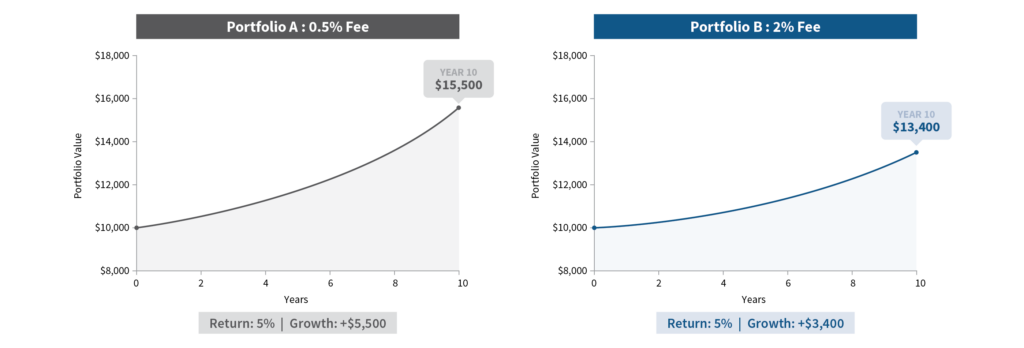
This example is hypothetical. The fees and returns shown do not reflect any specific portfolio or financial product.
This scenario is intended to illustrate the impact of a fee increase only, and is not indicative of actual or future investment performance.
The Performance Cost
In order to offer investment services at such a low rate, what these discount providers are stripping away is the expertise of a portfolio manager.
Time, attention, experience and knowledge go into actively managing the individual securities in a portfolio, and this expertise is dedicated to helping investors pursue growth while avoiding behavioural pitfalls like loss aversion and narrative pressure.
Altogether this results in a higher fee, but with a very important objective: better performance.
I would invite you to explore the published returns for a discount or online provider, compared with the net-of-fee returns of a leading mutual fund or, even better, your portfolio with the Wilson Financial Team.
Without an expert manager or proven investment discipline, what an investor has is an unmanaged grouping of securities. In my opinion, this bears more resemblance to a passive index fund than a personalized portfolio.
So if we return to our hypothetical example and chart the posted returns for an online provider and a managed mutual fund, the trajectory of that $10,000 would look more like this:
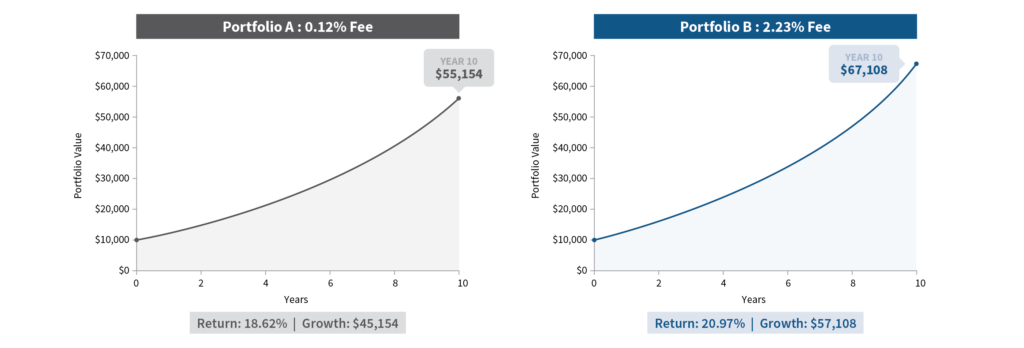
This is a hypothetical example drawn from the posted performance data of two funds with similar risk profiles.
Portfolio A represents the net-of-fee growth of $10,000 invested in the Questwealth Growth Portfolio, earning the current (as of July 21, 2026) 3yr performance rate of 18.62%.
View full return data here: https://www.questrade.com/questwealth-portfolios/etf-portfolios#growth
Portfolio B represents the net-of-fee growth of $10,000 invested in the Fidelity Global Growth Portfolio, earning the current (as of July 21, 2026) 3yr performance rate of 20.97%.
View full return data here: https://www.fidelity.ca/en/products/funds/ggp/
Additional Fees
It’s also worth noting that these discount and online brokerage fees may be lower, but they are not all-inclusive. Investors are often faced with additional costs for any administrative actions, like transfers or tax slips, and related services like financial planning or retirement strategy are generally not available at all. In our next post, we’ll share more about what it means to invest on an all-inclusive wealth management platform, and the additional value it can provide without additional fees.
So while the expense ratio is an important metric, it doesn’t tell the whole story when it comes to the value of advice. Managed portfolios can outperform—after fees—and that’s ultimately what’s going to help you grow your net worth.

Jim Wilson, B.Comm., CFP®
Senior Wealth Advisor
jim.wilson@iaprivatewealth.ca | Tel. (289) 644-1476